Running vs Clumping Bamboo: The Complete UK Comparison
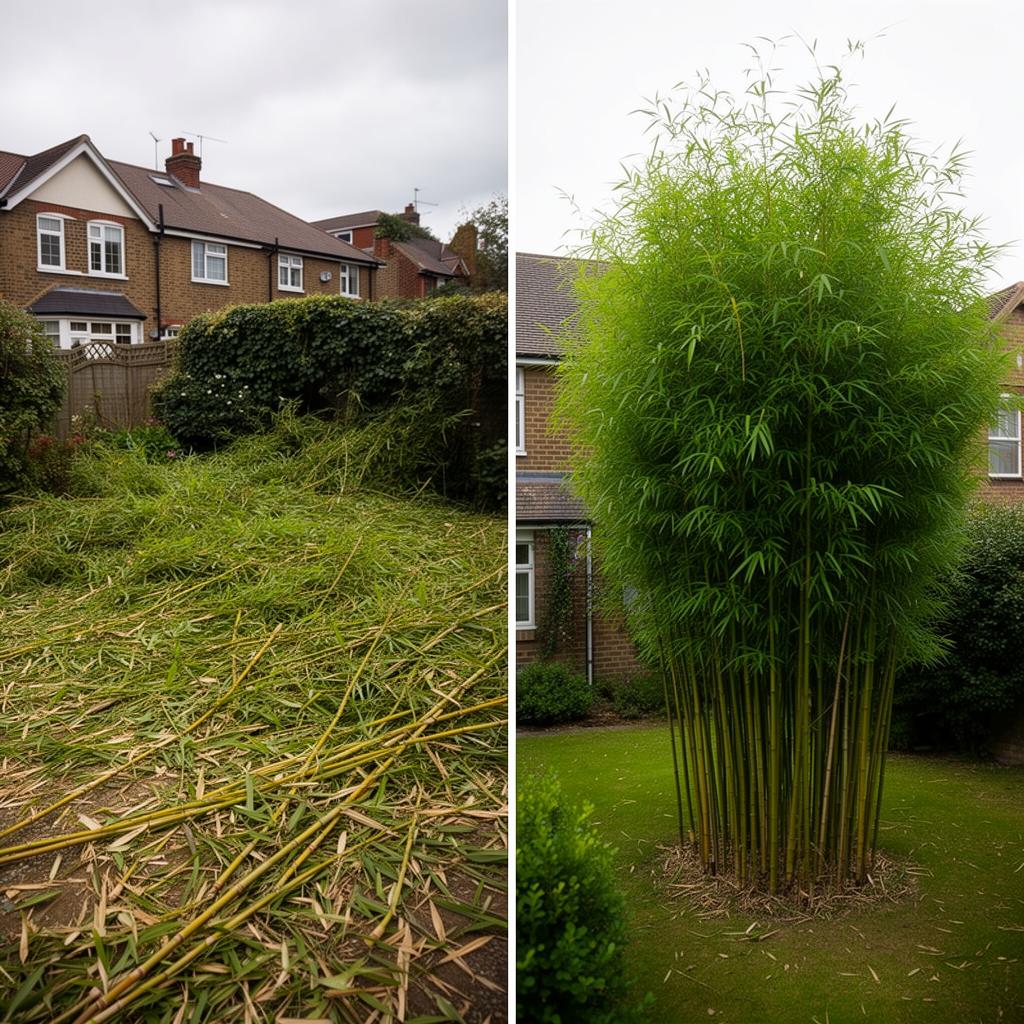
| Factor | Running Bamboo | Clumping Bamboo |
|---|---|---|
| Growth pattern | Monopodial rhizomes travel laterally away from the plant | Sympodial (U-shaped) rhizomes turn up close to the clump |
| Spread rate | Varies widely by species, age and ground conditions — often up to several metres in a season | Usually slow clump expansion, commonly cited as around 5–15cm a year |
| Root depth | Typically 15–60cm; deeper in loose or disturbed ground | Typically 15–40cm |
| Structural damage potential | Can be significant where rhizomes reach gaps or cracks in paving, drains and walls — depends on the condition of those structures | Much lower, but not nil if planted hard against a wall, drain or paving |
| Neighbour disputes | Common where boundaries are close and no barrier is in place | Uncommon, because lateral travel is limited |
| Mortgage and survey impact | May be noted by surveyors; lender and insurer requirements vary and the decision is theirs | Less often raised, but a surveyor may still comment on position or condition |
| Cold hardiness (UK) | Varies by species — many are hardy | Fargesia species are generally hardy |
| Removal cost | £1,500–£15,000+ — illustrative range, confirmed after survey | £200–£1,500 — illustrative range, often manageable |
| Root barrier | Usually advised if retaining, per RHS containment guidance; needs installing correctly and monitoring | Often unnecessary, depending on position |
Overview
Not all bamboo behaves the same way. The most useful distinction is between running bamboo (monopodial rhizomes that travel laterally) and clumping bamboo (sympodial rhizomes that turn upward close to the parent plant). The RHS bamboo growing guide describes this difference in habit and is clear that the practical outcome depends on the species and the situation rather than on the label alone.
Running habit means a plant has more potential to spread; it does not automatically mean damage or a dispute. Equally, clumping habit lowers the risk but does not make a plant risk-free in every position. What matters on a specific property is the species, how long it has been established, how far the rhizomes have already travelled, the condition of nearby structures and drains, the ground conditions, and what an assessor finds when the ground is checked.
Many garden centres and online retailers still sell running species with little explanation of how far they can travel, so plants bought for screening are often the ones we are later asked to look at.
How to Identify Your Bamboo
If you already have bamboo and need to know which type it is, here are the key identification methods:
Signs of Running Bamboo
- New shoots appearing away from the main stand — if bamboo canes are popping up in scattered locations, even metres from the main clump, it's running bamboo
- Rhizomes visible at the surface — running bamboo rhizomes sometimes emerge from the soil, appearing as hard, jointed, horizontal stems
- Rapid lateral spread — if your bamboo has noticeably expanded its footprint each year, it's almost certainly a runner
- Smooth, polished culms — many running varieties (Phyllostachys) have distinctively smooth, often coloured stems
Signs of Clumping Bamboo
- Tight, dense growth pattern — all canes emerge from a central point and the clump expands very slowly
- No scattered shoots — you won't find stray bamboo appearing away from the main plant
- Arching habit — many clumping varieties (especially Fargesia) have gracefully arching canes
- Thinner canes — clumping varieties in the UK typically have thinner culms than running species
Still unsure? We offer free bamboo identification as part of our site assessments. A quick visit can confirm what you're dealing with and whether action is needed.
Running Bamboo — Why It Spreads
Running bamboo spreads through monopodial rhizomes: horizontal underground stems that grow outward from the parent plant, usually at around 15–60cm depth, sending up new culms at intervals. Under favourable conditions a stand can extend by several metres in a growing season, but the RHS bamboo growing guide treats vigour as species- and site-dependent — a young plant in heavy, compacted clay behaves very differently from an established Phyllostachys in loose, cultivated soil. The only reliable way to know the extent on a given property is to trace it.
Where rhizomes reach a structure, the risk depends heavily on what they meet. Sound, well-jointed concrete and modern pipework are far more resistant than aged paving, dry-jointed walls or already-cracked drainage. In practice, problems we see tend to involve rhizomes and canes exploiting existing gaps, joints and cracks:
- Lifting or displacing paving and tarmac where bedding is thin or joints have opened
- Entering drains through failed joints or existing cracks, contributing to blockages
- Following gaps around service entries, cavity openings or damaged pointing
- Emerging through decking, borders or thin surfacing
- Crossing a boundary underground where nothing contains them
Rhizome fragments left in the ground can regenerate, which is why the Property Care Association emphasises surveyed, method-based removal and monitoring rather than one-off digging. How much material has to be removed, and how long monitoring runs, is a survey finding rather than a fixed rule.
Clumping Bamboo — Lower Risk, Not No Risk
Clumping bamboo has sympodial rhizomes — short, U-shaped underground stems that turn upward and produce new culms close to the parent plant. Clump expansion is usually slow, commonly described as a few centimetres to around 15cm a year, though this varies with species, age, moisture and how well the plant is doing.
In most garden settings that makes clumping bamboo a much lower-risk choice, and the RHS bamboo growing guide recommends clump-forming genera such as Fargesia where spread is a concern. It is fair to say clumping bamboo is far less likely to cause problems — not that it is guaranteed safe in every position. Points worth checking:
- A mature clump planted hard against a wall, drain run or paving edge can still exert pressure as it thickens
- Clumps grow steadily larger and can outgrow the space they were given, particularly in a small garden
- Correct identification matters — some plants sold as "clumping" are not, and a few genera behave differently in mild, damp conditions
- Surveyors may still comment on any bamboo close to a structure, depending on what they observe
Removal, if it is wanted, is usually a matter of taking out the central root mass rather than tracing distant rhizomes.
Common UK Species
Commonly Encountered Running Species
These are the species we are most often asked to deal with. Vigour still varies between plants and sites, so presence of one of these is a reason to assess rather than a conclusion in itself.
- Phyllostachys aurea (Golden Bamboo) — one of the most common garden escapees in the UK
- Phyllostachys nigra (Black Bamboo) — popular ornamental, can spread widely once established
- Phyllostachys bissetii — often sold for screening, vigorous in favourable conditions
- Pseudosasa japonica (Arrow Bamboo) — very common in older UK gardens, vigorous spreader
- Pleioblastus species — low-growing runners that colonise large areas
- Sasa species — broad-leaved runners, common in woodland gardens
Commonly Recommended Clumping Species
These are generally the lower-risk choices for UK gardens, subject to giving them enough room and keeping them clear of structures.
- Fargesia murielae (Umbrella Bamboo) — the most popular UK clumping bamboo, very hardy
- Fargesia nitida (Fountain Bamboo) — elegant arching habit, shade-tolerant
- Fargesia robusta — taller clumper, good for screening
- Fargesia dracocephala — compact, excellent for smaller gardens
- Chusquea culeou — South American clumper, hardy in southern UK
Property Risk Assessment
There is no single distance or figure that decides whether bamboo is a problem. Risk is a combination of factors, and they interact:
- Species and habit — running species have more potential to travel, but vigour differs between species and individual plants
- Proximity to structures — the closer a stand is to buildings, drains, paving or a boundary, the less margin there is. Short distances warrant closer inspection, but proximity alone is not proof of damage or of future damage
- Condition of those structures — sound concrete, intact pointing and modern pipework are considerably more resistant than aged, cracked or poorly jointed elements
- Ground conditions — loose, cultivated or disturbed soil allows easier rhizome travel than compacted or stony ground; made ground and service trenches can act as routes
- Age and management — a long-established, unmanaged stand normally has a wider network than a recent planting
- Containment — whether a barrier exists, whether it was installed correctly, and whether it has been checked. The RHS bamboo growing guide notes containment needs ongoing attention rather than being a fit-and-forget measure
- Evidence of spread — shoots appearing away from the stand, or in an adjoining garden, indicate active travel
Clumping bamboo will usually score low on most of these, but it should still be assessed on position and condition rather than assumed to be irrelevant. A Property Care Association survey approach — identify, trace, then recommend — is what turns these factors into a view on a specific property. Any judgement here reflects what the assessor can actually see and access on the day.
When Removal Is Worth Considering
Removal is one option among several — the alternatives are managed containment, a phased treatment programme, or monitoring. Which is appropriate depends on the survey findings. Running bamboo is more likely to warrant intervention where:
- It sits close to a structure, drain run or boundary, particularly where those elements are already cracked, aged or poorly jointed
- Shoots have appeared outside the original planting area, which indicates the rhizomes are travelling
- There is no barrier, or an existing barrier has not been checked and cannot be relied on
- A neighbour has raised encroachment, which is normally a civil matter and best addressed early
- You are selling or remortgaging. Surveyors may comment on it and some lenders or insurers ask for a management plan or guarantee — requirements vary between firms and the decision rests with them, so it is not possible to say in advance that it will or will not be raised
Clumping bamboo less often needs professional removal, and where it does the work is usually limited to the central root mass. That said, position, size and the condition of anything adjacent can change the picture, so it is worth checking rather than assuming.
Our free site assessment is intended to answer this properly: identify the species, trace the extent of any spread, look at the structures and ground involved, and then set out the realistic options.
The Verdict
Habit is the right starting point, not the whole answer. Running bamboo has far more potential to spread and is the type behind most of the work we do; clumping bamboo is a considerably lower-risk garden choice and, per the RHS bamboo growing guide, the sensible option where spread is a concern. But whether either needs action on your property depends on the species, how far it has already gone, the condition of nearby structures and drains, the ground, and what an assessor finds on site. Identify what you have, get it looked at if it is near anything that matters, and take advice on your own circumstances rather than relying on a general rule.
Our Expert Verdict
Running (monopodial) bamboo is the habit most likely to cause problems, because its rhizomes travel laterally away from the parent plant. Clumping (sympodial) bamboo expands far more slowly and is much less often a concern, though it is not risk-free in every position. How much either matters on a specific property depends on the species, how far the rhizomes have already travelled, the condition of nearby structures and drains, the ground conditions, and what an assessor actually finds on site. Identifying the habit is the first step, not the whole answer.
Need professional bamboo removal?
Free, no-obligation site assessments across South Wales.
Call 07582 869979Frequently Asked Questions
Related Articles
The History of Bamboo in the UK: How an Exotic Plant Became a Property Nightmare
Bamboo first arrived in British gardens during the Victorian plant-hunting era. What was once a prized exotic specimen has become one of the most problematic invasive plants in UK properties.
Japanese Knotweed vs Bamboo: Which Is Worse for Your Property?
Both Japanese knotweed and bamboo are invasive plants that can devastate UK properties. But which poses the greater threat? We compare the two side by side.
How Much Does Bamboo Removal Cost in the UK? 2026 Price Guide
Bamboo removal costs vary significantly based on the size of the infestation, access, and method used. Our comprehensive 2026 price guide breaks down what you can expect to pay.
Related Guides
More Comparisons
Sources
- RHS — Bamboo growing guideSpecies behaviour, running vs clumping habit and containment advice.
- Property Care Association — Invasive weed controlIndustry standards for surveys, management plans and insurance-backed guarantees.
- GOV.UK — Prevent harmful weeds and invasive plants spreadingWhich plants are subject to statutory control in England and Wales.
- HSE — PesticidesLegal requirements for professional herbicide use and operator certification.
- GOV.UK — How to resolve neighbour disputesThe recommended order of steps before any formal or legal action.
- Anti-social Behaviour, Crime and Policing Act 2014The discretionary Community Protection Notice powers councils may use.
- Wildlife and Countryside Act 1981, Schedule 9The schedule of listed plants — bamboo is not listed on it.
Limitations of this page
- Written from our own survey and removal work in South Wales together with the published guidance above. It is general information, not a site-specific assessment.
- Bamboo behaviour varies by species, ground conditions, planting age and how the plant has been managed, so figures given here are illustrative rather than predictive.
- Any cost, timescale or guarantee figure is an indicative range. Eligibility, term and exclusions for a guarantee depend on the method used and the site.
- Nothing here is legal advice. Boundary and damage questions are civil matters and depend on your circumstances — take independent legal advice before acting.
- Running and clumping are descriptions of growth habit, not risk ratings — vigour varies between species, individual plants and sites.
- Whether bamboo is a problem on a given property depends on the species, how far the rhizomes have already travelled, the condition of nearby structures and drains, the ground conditions, and what an assessor can see and access on the day.
- Distances, spread rates and costs given here are illustrative, not thresholds or predictions for your site.
Where We Work
We're a Neath-based team covering South Wales. Popular areas:
See all South Wales coverageNeed Help With Bamboo?
Get a free, no-obligation assessment from our PCA-registered specialists.
Call 07582 869979