Bamboo vs Japanese Knotweed: Which Is More Damaging?
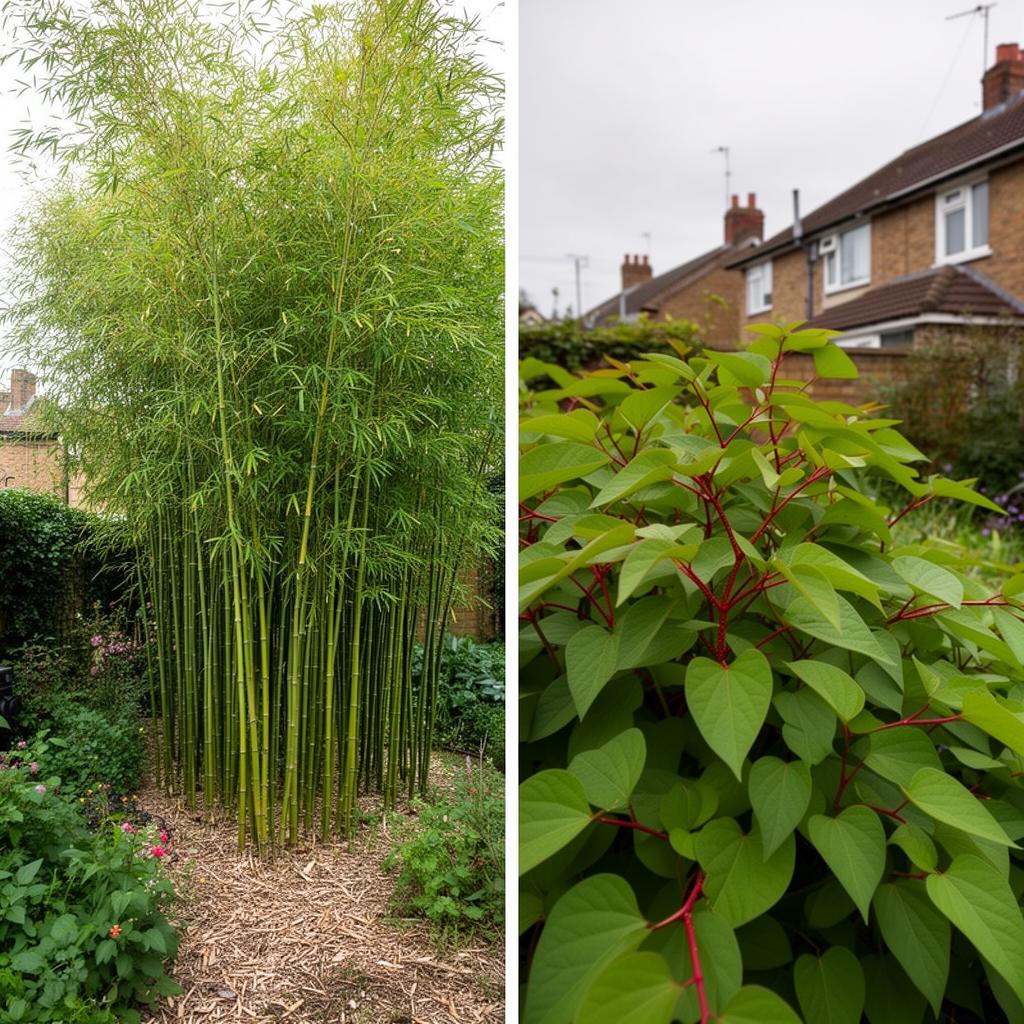
| Factor | Bamboo | Japanese Knotweed |
|---|---|---|
| Root depth | 15–60cm typical, up to 1m | Up to 3m deep |
| Lateral spread rate | Varies by species and conditions — often several metres a season | 1–2m per year |
| Listed as invasive | Not formally listed | Wildlife & Countryside Act 1981 |
| Mortgage impact | Increasingly flagged by surveyors | Can prevent mortgage approval |
| Excavation cost | £1,500–£15,000+ | £2,000–£20,000+ |
| Regrowth from fragments | Yes — any rhizome piece | Yes — 0.7g can regrow |
| Insurance-backed guarantee | Available (10 years) | Available (10 years) |
Overview
Bamboo and Japanese knotweed are the two most problematic invasive plants affecting UK properties. Both spread through underground rhizome networks and both can cause serious structural damage. However, they differ significantly in their legal status, growth habits, and removal approaches.
Homeowners often discover one while researching the other — and occasionally find both on the same property. Understanding the differences is essential for choosing the right removal strategy and understanding your legal obligations.
How They Spread
Bamboo (running varieties) spreads through horizontal rhizomes that can extend several metres in a growing season. The rhizomes travel just below the soil surface at 15–30cm depth, sending up new shoots at intervals. A single plant can colonise a large garden within 2–3 years.
Japanese knotweed spreads more slowly laterally (1–2m per year) but its rhizomes penetrate far deeper — up to 3 metres below ground and 7 metres from the visible plant. It also spreads through tiny stem or rhizome fragments carried in soil, water, or garden waste.
Both plants are virtually impossible to kill by cutting alone. Cutting stimulates the rhizome to produce more shoots, potentially making the problem worse.
Structural Damage Potential
Bamboo rhizomes can crack concrete paths, lift paving, exploit gaps in cavity walls, block drains, and push through tarmac. The canes themselves can grow through decking, sheds, and conservatories. In South Wales, we regularly see bamboo damage to boundary walls, patios, and drainage systems.
Japanese knotweed exploits existing weaknesses in structures rather than creating new ones. It grows through cracks in concrete, mortar joints, and gaps around pipes. Its deep root system can undermine shallow foundations, though it rarely cracks sound concrete on its own.
In practical terms, both can cause thousands of pounds in property damage. The key difference is that knotweed's deeper roots make it harder to fully excavate.
Legal Status in the UK
Japanese knotweed is listed under Schedule 9 of the Wildlife and Countryside Act 1981. Under section 14 of that Act it is an offence to plant it or otherwise cause it to grow in the wild. Contaminated soil containing knotweed is classified as controlled waste and must be disposed of at licensed facilities. Councils can also issue Community Protection Notices under the Anti-social Behaviour, Crime and Policing Act 2014, and owners may face civil liability in nuisance.
Bamboo is not listed under the Wildlife and Countryside Act 1981, and it is not a listed species under the Invasive Alien Species (Enforcement and Permitting) Order 2019. There is no statutory prohibition on planting or growing it. Encroachment across a boundary is normally a civil matter between neighbours — usually private nuisance or encroachment — decided on the facts of each case, so outcomes vary. Separately, surveyors may note bamboo on a property survey and some lenders ask about management, but this is a lending and valuation issue rather than a legal one. For your own situation, take independent legal advice; GOV.UK explains the practical route for resolving neighbour disputes.
Removal Difficulty
Bamboo removal typically involves excavating to 60–90cm depth. The rhizomes are tough but concentrated in the upper soil layers. Professional excavation can clear a domestic garden in 1–3 days with a high success rate.
Japanese knotweed removal is more complex due to the deeper root system. Full excavation may require digging to 3 metres or more. Herbicide treatment programmes typically run for 3–5 years (compared to 2–3 for bamboo). The deeper roots also make it harder to guarantee complete removal.
Cost Comparison
Both plants are expensive to remove professionally, but knotweed typically costs more due to the deeper excavation required and stricter waste disposal regulations:
- Bamboo excavation: £1,500–£15,000+ depending on area and access
- Knotweed excavation: £2,000–£20,000+ with controlled waste disposal
- Bamboo herbicide programme: £500–£2,500 over 2–3 seasons
- Knotweed herbicide programme: £1,500–£5,000+ over 3–5 seasons
The Verdict
Japanese knotweed has the worse legal status and deeper roots, but bamboo spreads faster and can cause equally devastating property damage. Neither should be underestimated or left untreated. If you have either plant on your property, professional assessment and removal is strongly recommended.
Our Expert Verdict
Both are highly invasive. Japanese knotweed is listed under Schedule 9 of the Wildlife and Countryside Act 1981; bamboo is not listed under that Act or the Invasive Alien Species Order 2019, so bamboo problems are handled as civil neighbour matters. Bamboo can still cause equal or greater structural damage, so neither should be ignored.
Need professional bamboo removal?
Free, no-obligation site assessments across South Wales.
Call 07582 869979Frequently Asked Questions
Related Articles
The History of Bamboo in the UK: How an Exotic Plant Became a Property Nightmare
Bamboo first arrived in British gardens during the Victorian plant-hunting era. What was once a prized exotic specimen has become one of the most problematic invasive plants in UK properties.
Japanese Knotweed vs Bamboo: Which Is Worse for Your Property?
Both Japanese knotweed and bamboo are invasive plants that can devastate UK properties. But which poses the greater threat? We compare the two side by side.
How Much Does Bamboo Removal Cost in the UK? 2026 Price Guide
Bamboo removal costs vary significantly based on the size of the infestation, access, and method used. Our comprehensive 2026 price guide breaks down what you can expect to pay.
Related Guides
More Comparisons
Sources
- RHS — Bamboo growing guideSpecies behaviour, running vs clumping habit and containment advice.
- Property Care Association — Invasive weed controlIndustry standards for surveys, management plans and insurance-backed guarantees.
- GOV.UK — Prevent harmful weeds and invasive plants spreadingWhich plants are subject to statutory control in England and Wales.
- HSE — PesticidesLegal requirements for professional herbicide use and operator certification.
- GOV.UK — How to resolve neighbour disputesThe recommended order of steps before any formal or legal action.
- Anti-social Behaviour, Crime and Policing Act 2014The discretionary Community Protection Notice powers councils may use.
- Wildlife and Countryside Act 1981, Schedule 9The schedule of listed plants — bamboo is not listed on it.
Limitations of this page
- Written from our own survey and removal work in South Wales together with the published guidance above. It is general information, not a site-specific assessment.
- Bamboo behaviour varies by species, ground conditions, planting age and how the plant has been managed, so figures given here are illustrative rather than predictive.
- Any cost, timescale or guarantee figure is an indicative range. Eligibility, term and exclusions for a guarantee depend on the method used and the site.
- Nothing here is legal advice. Boundary and damage questions are civil matters and depend on your circumstances — take independent legal advice before acting.
- Running and clumping are descriptions of growth habit, not risk ratings — vigour varies between species, individual plants and sites.
- Whether bamboo is a problem on a given property depends on the species, how far the rhizomes have already travelled, the condition of nearby structures and drains, the ground conditions, and what an assessor can see and access on the day.
- Distances, spread rates and costs given here are illustrative, not thresholds or predictions for your site.
Where We Work
We're a Neath-based team covering South Wales. Popular areas:
See all South Wales coverageNeed Help With Bamboo?
Get a free, no-obligation assessment from our PCA-registered specialists.
Call 07582 869979