How Bamboo Rhizomes Spread Underground
Understanding how bamboo spreads underground is the single most important thing any homeowner dealing with bamboo needs to know. The visible canes — or culms — are only a fraction of the story. Beneath the soil surface lies an aggressive, fast-growing rhizome network that is the true engine of bamboo's invasive behaviour. This guide explains exactly how this underground system works, how quickly it spreads, and why it makes bamboo one of the most challenging plants to remove in the UK.
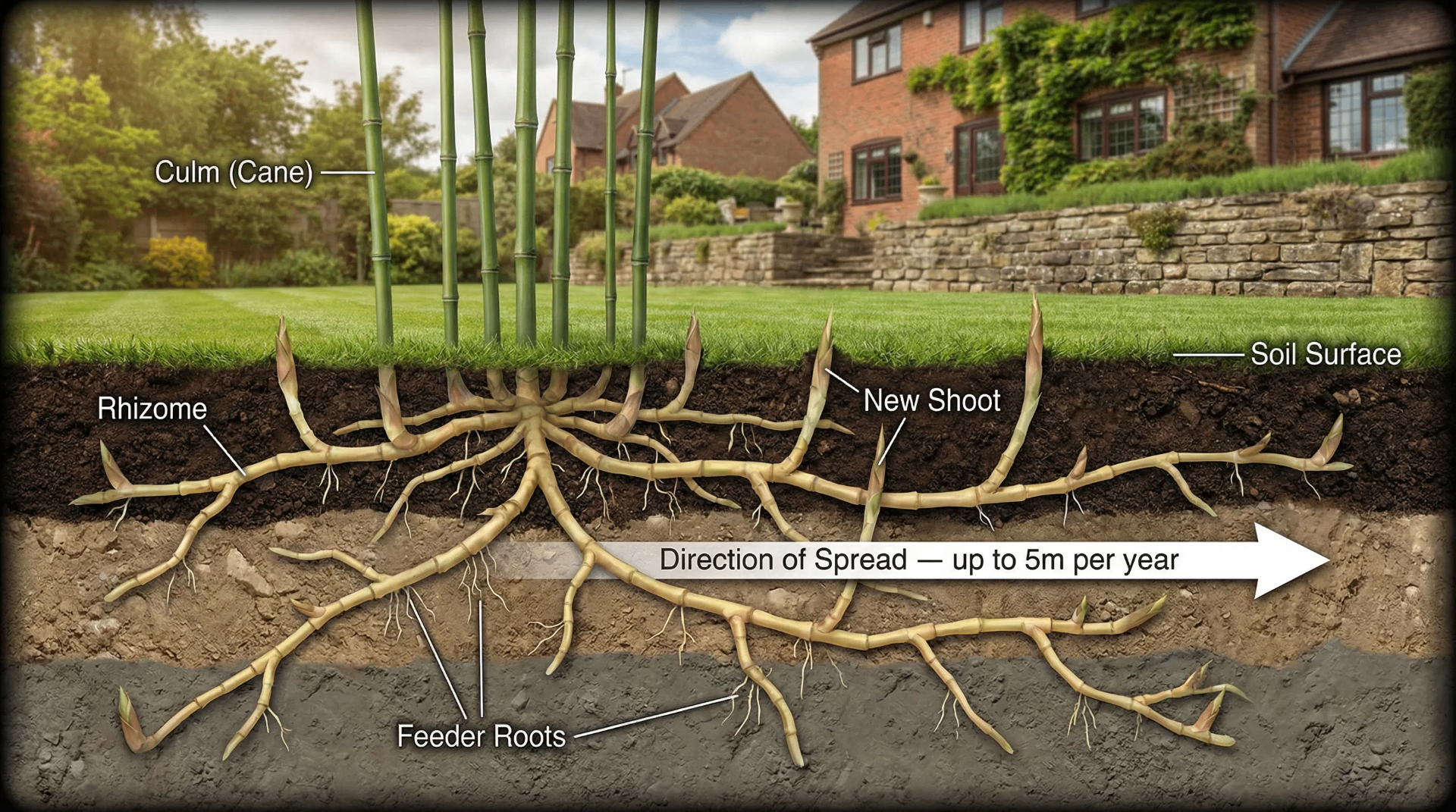
Anatomy of the Bamboo Rhizome System
A bamboo plant has four key structural components below and at the soil surface:
- Culms (Canes): The tall, visible stems growing above ground. These are the part most people think of as "the bamboo," but they are simply vertical shoots produced by the rhizome system below.
- Rhizomes: Thick, woody underground stems that grow horizontally through the soil. Rhizomes are the primary means of spreading — they branch, extend, and produce new culms and roots at regular nodes along their length.
- New Shoots: At each node along the rhizome, a bud can produce a new vertical shoot that pushes up through the soil to become a new culm. This is how bamboo colonises new ground — shoots appear metres away from the original plant, seemingly out of nowhere.
- Feeder Roots: Fine, fibrous roots that grow downward from the rhizome nodes into deeper soil. These absorb water and nutrients to fuel the rhizome's relentless horizontal growth.
The entire system operates as a single connected organism. When you see bamboo canes scattered across a garden, they are almost always connected underground by the same rhizome network — which is why cutting individual canes does nothing to stop the spread.
How Fast Do Rhizomes Spread?
Running bamboo rhizomes can extend at a remarkable rate. In UK growing conditions — particularly in the mild, wet climate of South Wales — rhizomes can spread several metres in a growing season. Spread varies by species and growing conditions, so an assessment is the only way to map the actual extent on a given property. During peak growing season (May to September), individual rhizome tips can grow several centimetres per day.
This means a bamboo plant in one corner of a garden can have rhizomes reaching the opposite boundary within a single growing season. Critically, rhizomes don't grow in straight lines — they branch at nodes, sending out multiple advancing fronts simultaneously. Within 2–3 years, a single planting can produce a dense underground network spanning the entire garden and beyond into neighbouring properties.
The speed of spread depends on several factors:
- Species: Phyllostachys bissetii and Pseudosasa japonica are among the fastest spreaders in UK conditions
- Soil type: Loose, well-drained soils allow faster rhizome travel. Heavy clay slows them slightly but doesn't stop them
- Moisture: Consistent rainfall accelerates growth — one of the reasons bamboo is so aggressive in Wales
- Age of plant: Established bamboo with a mature rhizome network spreads faster than young plants
How Deep Do Rhizomes Grow?
Most bamboo rhizomes in UK soils grow at depths of 15–30cm below the soil surface. This relatively shallow depth is part of what makes them so effective — they sit in the nutrient-rich topsoil where water and organic matter are most available.
However, established bamboo plants can push rhizomes deeper:
- Typical range: 15–30cm for the majority of the rhizome network
- Mature plants: 45–60cm, especially in loose or sandy soils
- Extreme cases: Up to 1 metre deep where rhizomes follow existing root channels, drainage pipes, or cracks in hard surfaces
This is why DIY removal attempts that only dig to spade depth (around 20cm) consistently fail. A professional excavation digs to 60–90cm to ensure the entire rhizome network is captured — including the deeper runners that amateur digging misses entirely.
How New Shoots Emerge
New bamboo shoots are produced from buds at the nodes along the rhizome. Each node has the potential to generate either a new vertical shoot (which becomes a culm) or a new horizontal branch of the rhizome (which extends the underground network further).
In spring and early summer, rhizome buds activate and push new shoots vertically through the soil. These shoots can grow astonishingly fast once they emerge — some species add 30cm or more of height per day during peak growth. Within weeks, a shoot emerging from bare ground can become a mature cane several metres tall.
Homeowners are often alarmed when new bamboo shoots appear in unexpected places — in a flower bed 3 metres from the main stand, pushing up through a patio, or even in a neighbour's garden. This is the rhizome system at work: the shoot was programmed underground months before it became visible, travelling unseen through the soil.
The Role of Feeder Roots
While rhizomes handle horizontal spread, feeder roots handle sustenance. These fine, fibrous roots grow downward from the rhizome nodes into the surrounding soil, absorbing water and dissolved minerals that fuel the entire network.
Feeder roots are important for several reasons:
- They anchor the rhizome system in place, making extraction more difficult
- They allow the rhizome to sustain rapid growth even in poor soils
- During herbicide treatment, the feeder root system helps distribute the chemical throughout the rhizome network — which is why professional stem injection can be effective
- Even small rhizome fragments with intact feeder roots can regenerate into new plants
Why Rhizome Spread Is So Dangerous
The underground nature of bamboo spread creates several serious risks for UK homeowners:
Structural Damage
Bamboo rhizomes can exploit any crack or weakness in built structures. They regularly exploit and widen existing cracks in concrete foundations, exploit gaps in cavity walls, crack tarmac driveways, and infiltrate drainage systems. The force exerted by growing rhizomes is considerable — the site-specific risk depends on the species, the extent of spread, ground conditions and the condition of the structure.
Boundary Encroachment
Because rhizomes travel underground, bamboo frequently crosses property boundaries without any visible above-ground warning. By the time shoots appear in a neighbour's garden, the rhizome network may have been spreading under their property for months. This creates legal liability for the property owner where the bamboo was originally planted.
Property Value Impact
Mortgage lenders increasingly flag bamboo as a concern during property valuations. An uncontrolled bamboo infestation can reduce property value, delay sales, and in some cases make a property unmortgageable until a professional management plan is in place.
Hidden Scale
Perhaps the most dangerous aspect is the discrepancy between what you can see and what's actually there. A small stand of 10–15 bamboo canes might have rhizomes extending 5 metres in every direction underground. The visible problem is always a fraction of the real problem.
Signs of Underground Rhizome Spread
Watch for these warning signs that bamboo rhizomes are actively spreading on your property:
- New shoots appearing away from the main stand — the clearest sign of active rhizome spread
- Cracking or lifting in hard surfaces — patios, paths, and driveways showing unexplained damage near bamboo
- Bulging in lawns or borders — raised ridges in turf indicating rhizomes just below the surface
- Blocked drains — rhizomes infiltrating drainage systems cause slow drainage and eventual blockages
- New growth along fence lines — rhizomes often follow the path of least resistance along fence post lines and boundary edges
If you notice any of these signs, the rhizome network is already well-established and professional assessment is recommended before the situation worsens.
How to Stop Rhizome Spread
Stopping bamboo rhizome spread requires targeting the underground network directly:
Root Barrier Installation
High-density polyethylene (HDPE) root barriers installed vertically to 60–90cm depth can physically block rhizome spread. Barriers must extend 5–10cm above soil level to prevent rhizomes growing over the top. This is effective for containment but does not remove existing bamboo.
Professional Excavation
Complete removal of the rhizome network through mechanical excavation is the most reliable way to stop spread permanently. All soil containing rhizome fragments must be removed to 60–90cm depth and the site screened to ensure no fragments remain.
Herbicide Treatment
Professional stem injection with glyphosate-based herbicide can kill the rhizome network over 2–3 growing seasons. The herbicide is translocated from the injected culm through the connected rhizome system, killing the underground network from within.
What Doesn't Work
- Cutting canes: This stimulates the rhizome to produce more shoots — making the problem worse
- Shallow digging: Rhizomes below spade depth survive and regenerate
- Consumer weedkillers: Too weak to reach and kill the rhizome system
- Covering with membrane: Rhizomes simply grow beyond the covered area and emerge elsewhere
The key message is that any effective control method must address the rhizome network — the hidden 90% of the bamboo plant. Surface-level interventions are ineffective because they don't reach the source of the problem. If you're dealing with spreading bamboo, a professional site assessment is the essential first step to understanding the true extent of the underground network and choosing the right removal strategy.
Need professional bamboo removal?
Free, no-obligation site assessments across South Wales.
Call 07582 869979Frequently Asked Questions
More Bamboo Guides
How to Remove Bamboo from a Garden in the UK
14 min readIs Bamboo Invasive in the UK?
10 min readBamboo Roots Spreading into Your Neighbour's Garden
11 min readHow Deep Do Bamboo Roots Grow?
9 min readBest Way to Kill Bamboo Permanently
10 min readBamboo Management Plan for Mortgage: What UK Lenders Require
11 min readBamboo Removal Cost UK: Complete Price Guide 2026
10 min readBamboo Survey Requirements UK: When & Why You Need One
9 min readHow Can I Tell If I Have Running Bamboo?
9 min readWhat Are the Most Invasive Bamboo Species in the UK?
9 min readCan Bamboo Grow Through Concrete?
8 min readCan Bamboo Damage a Patio or Driveway?
8 min readDoes Bamboo Reduce Property Value?
9 min readCan I Sell a House With Invasive Bamboo?
9 min readIs Bamboo Damage Covered by Home Insurance?
8 min readWho Pays to Remove a Neighbour's Bamboo?
10 min readCan I Cut Bamboo Roots Coming Into My Garden?
9 min readThe Best Bamboo Root Barrier: What Works, What It Costs, and How It Fails
11 min readCan Bamboo Damage House Foundations?
12 min readCan Bamboo Damage Drains? Rhizomes in Pipes, Blocked Drains and What to Do
10 min readWhy Is My Bamboo Growing Back After Removal?
9 min readHow Is Excavated Bamboo Disposed Of in the UK?
9 min readHow Much Does Bamboo Excavation Cost? Prices by Area for 2026
10 min readRelated Articles
The History of Bamboo in the UK: How an Exotic Plant Became a Property Nightmare
Bamboo first arrived in British gardens during the Victorian plant-hunting era. What was once a prized exotic specimen has become one of the most problematic invasive plants in UK properties.
Japanese Knotweed vs Bamboo: Which Is Worse for Your Property?
Both Japanese knotweed and bamboo are invasive plants that can devastate UK properties. But which poses the greater threat? We compare the two side by side.
How Much Does Bamboo Removal Cost in the UK? 2026 Price Guide
Bamboo removal costs vary significantly based on the size of the infestation, access, and method used. Our comprehensive 2026 price guide breaks down what you can expect to pay.
Sources
- RHS — Bamboo growing guideSpecies behaviour, running vs clumping habit and containment advice.
- Property Care Association — Invasive weed controlIndustry standards for surveys, management plans and insurance-backed guarantees.
- GOV.UK — Prevent harmful weeds and invasive plants spreadingWhich plants are subject to statutory control in England and Wales.
- HSE — PesticidesLegal requirements for professional herbicide use and operator certification.
- GOV.UK — How to resolve neighbour disputesThe recommended order of steps before any formal or legal action.
- Anti-social Behaviour, Crime and Policing Act 2014The discretionary Community Protection Notice powers councils may use.
- Wildlife and Countryside Act 1981, Schedule 9The schedule of listed plants — bamboo is not listed on it.
Limitations of this page
- Written from our own survey and removal work in South Wales together with the published guidance above. It is general information, not a site-specific assessment.
- Bamboo behaviour varies by species, ground conditions, planting age and how the plant has been managed, so figures given here are illustrative rather than predictive.
- Any cost, timescale or guarantee figure is an indicative range. Eligibility, term and exclusions for a guarantee depend on the method used and the site.
- Nothing here is legal advice. Boundary and damage questions are civil matters and depend on your circumstances — take independent legal advice before acting.
Where We Work
We're a Neath-based team covering South Wales. Popular areas:
See all South Wales coverageNeed Help With Bamboo?
Get a free, no-obligation assessment from our PCA-registered specialists.
Call 07582 869979